History · 3 min read
The Creek and the Trading Town
The Creek divided the old trading town into Deira and Bur Dubai. Its waterfront still helps explain the city’s markets, buildings and trading routes.
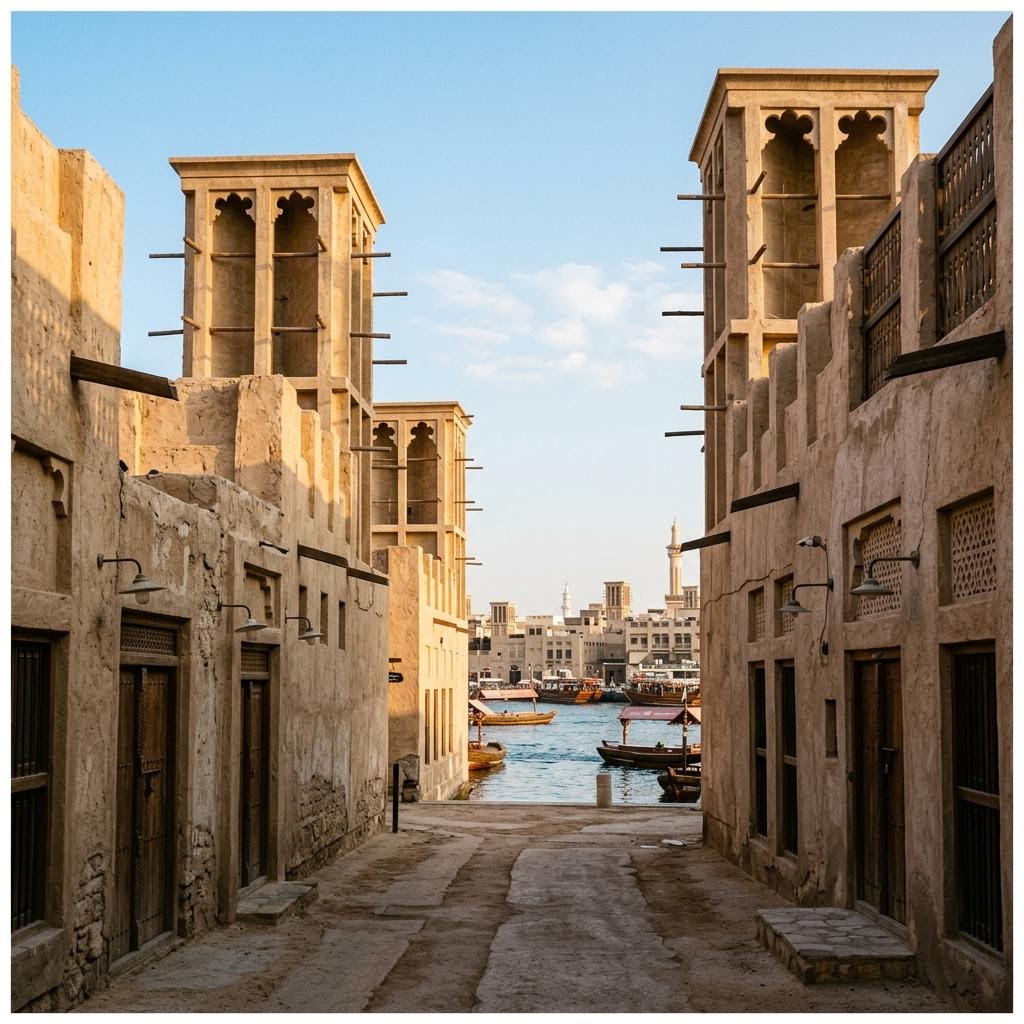
A saltwater inlet at the centre
Dubai Creek is a tidal inlet connecting the historic town to the Arabian Gulf. Bur Dubai lies to its west and Deira to its east. Before the modern skyline, the sheltered harbour supported fishing, pearl diving and trade with other ports.
It helps to picture the setting without the skyline. This was a low, sandy coast with fishing, pearl diving and small-scale trade as the working rhythm of the year. Communities lived close to the water because the water fed them, moved their goods and connected them with ports across the Gulf and beyond. The Creek was less a scenic feature than a working road.
Trade as an everyday skill
Historians generally describe the settlement as growing through the nineteenth century, with the Al Maktoum family leading the town from the 1830s. Trade was practical rather than glamorous: dhows carried dates, pearls, textiles, spices and household goods between the Gulf, the Indian subcontinent and East Africa. Merchants learned to deal with many languages and many customs, and that habit never really left.
A frequently cited turning point came in the early twentieth century, when the ruler of the time offered favourable terms to traders and the town became known as a place where merchants could operate with fewer obstacles. Details of the arrangements are best read in dedicated history sources, but the broad pattern is clear: Dubai prospered by being easy to do business in, and by drawing merchants who had options elsewhere.

Two banks, one working waterfront
Walk the Creek today and the older logic is still legible. Wooden dhows load and unload along the quays, and small abras ferry passengers between Deira and Bur Dubai for a short crossing that remains one of the most direct ways to feel the old geography. The markets that grew near the water still cluster there, while newer districts spread further inland and along the coast.
The two banks developed distinct personalities. Deira became closely associated with wholesale trade, spice and gold dealing and a dense, busy street life. Bur Dubai kept the historic residential quarters and the heritage lanes that now interest visitors. Neither bank is a museum; both continue to serve everyday needs for the people who live and work around them.
Reading the Creek as a visitor
The best way to understand the Creek is to move slowly along it. Take an abra at a time that suits the weather, notice the cargo stacked on the dhows, and let the pace of the waterfront reset your expectations of the city. Early morning and late afternoon are generally gentler for walking than midday, especially in the warmer months.
It is worth keeping in mind that the Creek has also been reshaped over time. Channels have been widened, extended and connected to newer projects, and the modern Creek area includes planned districts that did not exist in the trading era. That layering is part of the story: Dubai kept the old waterway and kept building around it. Treat the Creek as a starting point, then follow its themes of trade, tolerance and reinvention through the rest of the city.
Why the story still matters
The Creek explains habits that still define Dubai: an openness to newcomers, a preference for practical deals and a comfort with change. When people describe the city as international, they are often describing something that began on these banks, where traders from different places had to find common ground quickly and keep their word if they wanted to be welcome again.
It also guards against a common misunderstanding. Dubai is sometimes imagined as a city with no past, but the past is simply modest in scale and built from lighter materials. Coral, gypsum, palm wood and canvas do not survive like stone monuments, so the history lives in routes, names and routines as much as in buildings. Follow the water and you will find it.
Independent and unofficial. Details change; confirm with official sources before you travel.