Nature & sustainability · 2026 guide · 8 min read
Ras Al Khor in 2026: the wetland behind Dubai’s nature-tourism story
Ras Al Khor is Dubai’s most revealing nature story: a Ramsar-listed wetland embedded in an intensely urban setting, famous for winter flamingos yet defined by broader biodiversity, protected habitats, and carefully managed public access through bird hides and education-led visitation.
- Published
- Earlier source-check record
- Not separately recorded
- Content updated
- By
- ComeVisitDubai editorial
Update note: Clarified that three built hides do not establish current hide openings, hours or permit conditions. Edited for clarity and repetition, with contextual photographs added. This copy edit is not a new full-article source check.
Based on the linked sources, not a first-hand visit. “Today” and “this week” refer to the publication date. Source checks and later edits are recorded separately. Editorial method and attribution.
Access check: built hides are not a live opening notice
The municipality's habitat page describes three bird hides, but the text checked on 10 November 2026 did not establish which are currently open, their access routes, hours or any current registration or permission procedure. Do not assume all three are available simply because a conservation overview describes them. Obtain current visitor instructions from Dubai Municipality before setting out, use designated access only and do not enter protected habitat to reach a viewpoint.
Why Ras Al Khor matters in Dubai’s 2026 nature map
Ras Al Khor Wildlife Sanctuary is not just another urban green pocket; Dubai Municipality describes it as one of the world’s natural wonders because it is a wetland of declared international importance, set inside a hyper-arid environment and unusually embedded within one of the world’s most urbanized landscapes. That contrast is the core of its appeal. In Dubai, where many nature experiences lean toward purpose-built desert recreation or offshore coastal scenery, Ras Al Khor offers a different proposition: a protected ecological system that exists because the city has made room for it, not because it was waiting untouched at the edge of development.
The 2026 value of the sanctuary lies in how clearly it illustrates the tension between conservation and access. Dubai Municipality identifies it as a wetland reserve covering 10.13 km², with legal protection dating back to 1998 and Ramsar designation in 2007, the first wetland in the country to receive that international recognition. Those milestones matter because they show that Ras Al Khor’s significance is not promotional language added later for tourism; it is a long-running conservation case study that still shapes how visitors should understand the place now. The sanctuary’s role in the city is therefore both practical and symbolic: it preserves habitat, supports biodiversity, and anchors Dubai’s claim that urban growth and wildlife protection can coexist, at least in carefully managed form.
Flamingos are the headline, but the habitat is the real story
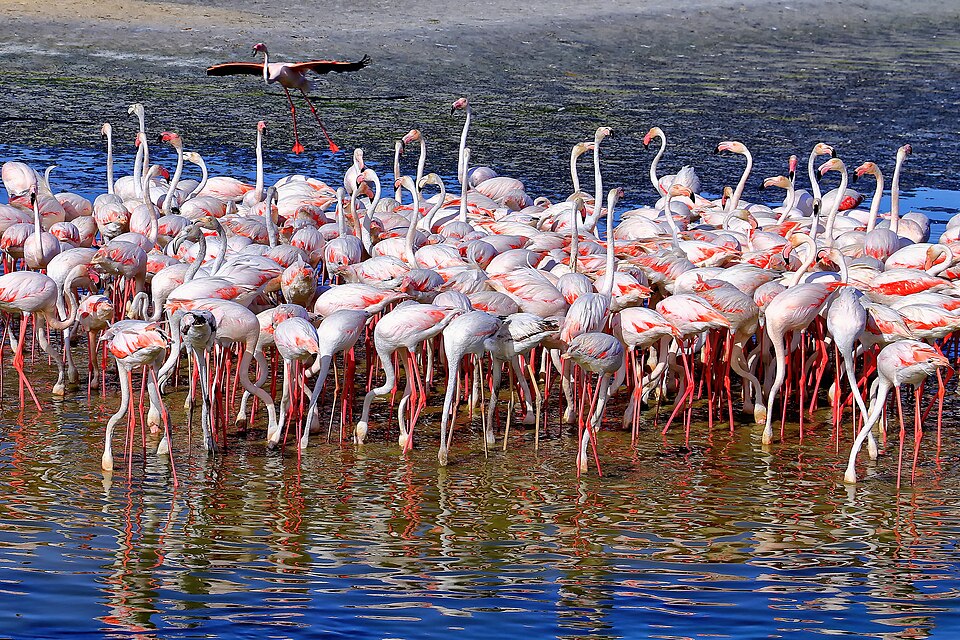
Most visitors first think of flamingos, and Dubai Municipality makes clear that they are the main attraction. But the sanctuary’s wildlife profile is far broader than a single photogenic species. In winter, bird numbers may reach up to 25,000 across 201 bird species, including mallards, pintails, common teals, waders, shorebirds, songbirds and raptors. The site also supports globally threatened water birds such as Socotra Cormorant, Ferruginous Ducks and Social Lapwing, which are listed on the IUCN Red List of Endangered Species. In other words, Ras Al Khor is not a decorative lagoon with a famous bird; it is a functioning habitat complex with enough ecological variety to support an unusually rich assemblage of birds and other wildlife.
The habitat list helps explain why the site remains important in 2026. Dubai Municipality identifies mangroves, intertidal areas, mudflats and sabkhas as key habitats, and those landscape types do different work within the ecosystem. Mudflats and intertidal zones are feeding grounds; mangroves and sheltered edges provide structure and refuge; sabkhas add to the site’s ecological mosaic. The sanctuary’s published species inventory goes well beyond birds too, with counts for mammals, reptiles, invertebrates, flora and fish contributing to a total of 472 species. For a visitor, that means the correct mental model is not “go see flamingos” but “go observe a wetland system whose visible birds are only the most accessible expression of a larger, more delicate habitat network.”
What the bird hides change about the visit
Dubai Municipality says it has built three bird hides at strategic locations so visitors can get a closer view of birds and other wildlife while keeping the surrounding habitat under less direct pressure. That detail is important because it shows how the sanctuary’s public experience has been designed around observation rather than immersion. Unlike a park where you move freely through the environment, Ras Al Khor asks visitors to accept distance as part of the conservation ethic. The hides are not an afterthought; they are the infrastructure that makes nature tourism possible without turning the wetland into a casual promenade.
This is where Ras Al Khor differs from many attraction-led destinations in Dubai. The hides create a controlled viewing experience that can support education, school visits and long-term awareness, and Dubai Municipality notes that the sanctuary has attracted more than 90,000 visitors from over 100 countries. That scale is meaningful, but it should not be mistaken for a guarantee of spectacle. Bird activity changes with season, tide, time of day and ecological conditions. If you plan to visit in 2026, treat the hides as a respectful viewing framework, not a promise that every stop will deliver the same scene. The right expectation is careful watching, patience and an acceptance that the sanctuary’s worth does not depend on a perfect photo opportunity.
Conservation first, attraction second
Ras Al Khor is one of the clearest examples in Dubai of a protected area where conservation logic comes before tourism convenience. The sanctuary is formally protected under local law, is part of the city’s protected-area system, and appears on Dubai Municipality’s protected habitats page alongside other reserves with very different ecologies, from desert to mountain to marine environments. That placement matters because it reminds visitors that Ras Al Khor is not a standalone tourist venue but part of a broader municipal conservation network. Dubai Municipality also states that it applies a science-based research and management approach, with partner collaboration, to keep the emirate’s nature reserves healthy and functioning.
For a traveler, the practical implication is that etiquette matters as much as timing. The sanctuary’s value depends on birds continuing to use it as habitat, not merely as a backdrop for visitors. So the most useful mindset is one of low-impact observation: stay within designated access points, avoid expecting access beyond what is built for public use, and understand that the sanctuary’s functioning is what makes it worth visiting. This is also why any discussion of “conservation versus attraction infrastructure” is not theoretical at Ras Al Khor. The bird hides, educational programming and regulated public access are the compromise. They make the wetland legible to visitors while trying not to erase the very qualities that make it ecologically important.

A wetland that shaped old Dubai as well as the present city
One of the sanctuary’s most overlooked dimensions is its cultural history. Dubai Municipality describes Ras Al Khor as an integral part of the UAE’s cultural and traditional heritage because it was an important spawning area for fish and supported traditional fishing that helped lead to the establishment of three early-18th-century settlements: Deira, Shindaga and Bur Dubai. That means the wetland is not merely adjacent to Dubai’s urban story; it helped make the city possible. In a place often discussed in terms of speed, finance and modern infrastructure, Ras Al Khor is a reminder that water ecology was once central to settlement patterns and economic life.
That historical layer gives the sanctuary a deeper reading in 2026. Visitors often arrive expecting a modern conservation site framed by skyline views, but the site also functions as a memory of how coastal and wetland resources shaped life before the city’s present scale. This is where an urban wetland becomes especially interesting: it connects environmental protection with heritage, showing that protecting habitat is not only about birds and biodiversity. It also preserves a geography that once supported people directly. For editorially minded travelers, that is what makes Ras Al Khor unusually compelling. It is a rare place where nature tourism, city history and environmental policy overlap in one relatively small but symbolically powerful landscape.
How to think about a 2026 visit
The current Dubai Municipality guidance is straightforward: Ras Al Khor Wildlife Sanctuary is open to the public year round. That wording is useful because it tells visitors not to treat the site as a seasonal event or a timed attraction with a fixed program. Instead, it is an accessible protected area that can be visited across the calendar, with wildlife conditions changing naturally over time. The same page also points visitors to binoculars, which is a subtle but important cue. The best experience comes from observation, not from expecting close approach or guaranteed encounters.
For practical planning, this means a 2026 visit should be built around realistic expectations. Go for the ecological setting and the chance to see birds in a managed wetland rather than for certainty of a dramatic flamingo gathering. Bring patience, avoid overpacking the visit with assumptions, and understand that the sanctuary’s appeal is strongest when you let it remain a living habitat rather than forcing it into the logic of a theme attraction. If you are comparing Dubai’s protected areas, Ras Al Khor stands out less for scale than for contrast: it is the city’s most urban wetland, and that makes every sighting, however modest, feel like evidence that conservation can still hold its ground inside the metropolis.
Why Ras Al Khor still defines Dubai’s nature-tourism story
Ras Al Khor continues to matter in 2026 because it shows what Dubai’s nature tourism can be when it is built around protection rather than spectacle alone. The sanctuary’s Ramsar status, its IUCN-linked conservation significance, the documented species diversity, the bird hides and the educational use of the site all point toward a model where visitor access reinforces stewardship instead of replacing it. That is a more mature tourism story than a simple “come see flamingos” pitch, and it is one of the reasons the sanctuary feels distinctive among Dubai’s protected areas.
For visitors, the takeaway is simple but useful: come to Ras Al Khor for context, not certainty. Come to understand how a wetland functions inside a major city, how a protected habitat can support migratory birds and threatened species, and how infrastructure can help people view nature without dominating it. The sanctuary’s real achievement is that it makes urban ecology visible. In a city famous for engineered ambition, Ras Al Khor remains one of the clearest places to see what careful restraint looks like when it is applied to land, water and wildlife.
Independent and unofficial. Part of an editorial selection of 90 topics, not a popularity ranking. Details change; confirm with official sources before you travel.
You might also want to read

Dubai air quality today: how to check the live AQI
Air quality can differ by place and hour. Here is where to check Dubai’s official live readings, what the index means and how to use it when planning time outdoors.
Read · 2 minAl Marmoom: why an unfenced reserve needs careful visitors
Al Marmoom is unfenced, but it is not a blank canvas. Dubai Municipality frames it as a protected desert system built for sustainable recreation, where lakes, hides, and wildlife habitats demand restraint, route awareness, and respect for conservation rules.
Read · 3 minDubai Desert Conservation Reserve: choosing a safari with conservation in mind
Dubai’s desert safaris are not all the same: the Dubai Desert Conservation Reserve is a managed protected landscape, while nearby open dunes are not automatically conservation experiences. Choosing well means reading the reserve’s ecology, visitor rules, and the purpose behind guided access.
Read · 6 min